
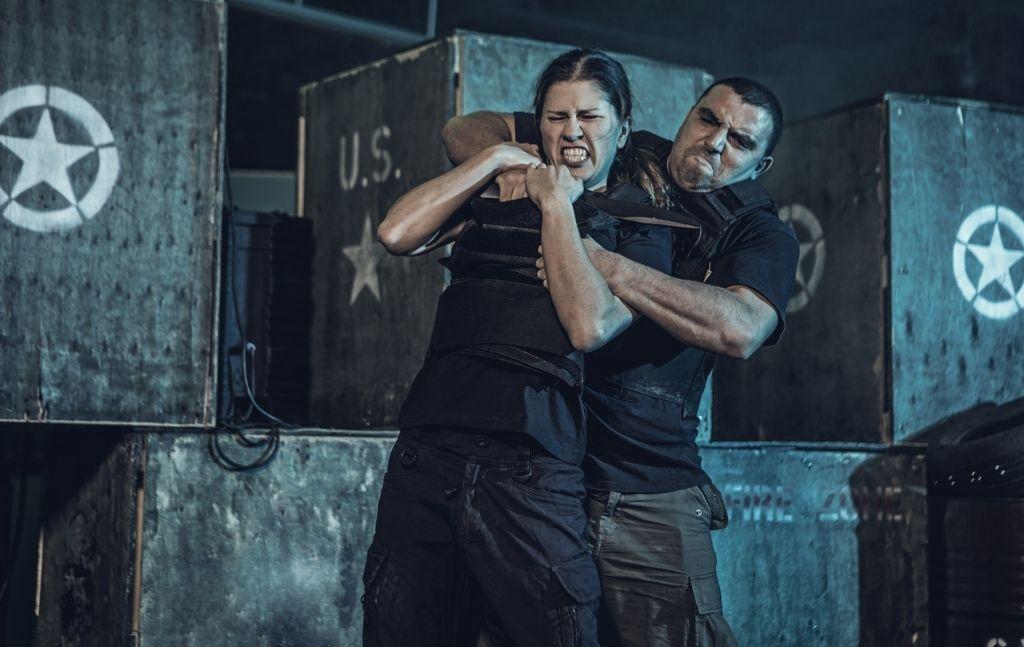
Defense · awareness · decisive movement
Krav Maga Techniques
Eight foundational movements to understand—and why real self-defense begins with awareness, distance, and trained judgment.
I have often wondered how I would react if faced with a dangerous attacker on the street. Training gave me a better understanding of self-defense, but no article can replace qualified, hands-on instruction.
This guide explains eight Krav Maga movements and the principles behind them. Avoidance, de-escalation, escape, and calling for help should remain the first choices whenever they are available.
Do not rehearse strikes against another person without a qualified instructor, protective equipment, and controlled training pads. Several techniques below can cause severe injury.
The system
What Is Krav Maga?
Krav Maga is a practical hand-to-hand combat system that includes strikes with the hands, elbows, knees, and feet, along with defenses, releases, and movement under pressure.
The system grew from the work of Imi Lichtenfeld and was developed for Israeli military and security training. Today, civilian schools around the world teach adapted versions for fitness and self-defense.
You do not need to master every movement before benefiting from training. Good instruction can improve awareness, balance, agility, reflexes, and the ability to make decisions under stress.
Principles before moves
How Does Krav Maga Work?

Krav Maga draws from striking, grappling, and wrestling disciplines. Its training emphasizes simple responses, simultaneous defense and counteraction, awareness of surroundings, and creating an opportunity to escape.
Progress depends on regular, supervised practice. A movement that looks simple when demonstrated can fail under resistance, poor balance, or stress. Train the basics slowly before adding speed and pressure.
The movement list
8 Krav Maga Moves for Self-Defense
Krav Maga combines defensive and offensive movement, often focusing on vulnerable areas when escape is otherwise impossible. Because several of these actions can cause permanent injury, the descriptions below are for understanding—not unsupervised partner practice.
Close range
Horizontal Elbow Strike
An elbow can generate substantial force at close range, but entering that range also increases risk. The striking arm travels horizontally while the hips and feet help drive the movement.
Training focus
Keep the non-striking hand protecting the head, maintain posture, and practice returning immediately to a guarded position. Work only on pads with an instructor.
Close range
Front Knee Strike
From a stable guard, the knee drives forward and upward before the foot returns quickly to the floor. Balance and control matter more than height.
Training focus
Keep your hands protecting your head, avoid leaning backward, and recover your stance immediately. Train against a properly held pad rather than a partner’s body.
Advanced
Reverse Scissor Sweep
This takedown uses coordinated upper- and lower-body pressure to disrupt an opponent’s balance. It is much more complex than basic striking and can injure both people if performed incorrectly.
Training focus
Beginners should build mobility, breakfall skills, and balance first. Attempt the sweep only with an instructor, a trained partner, and suitable mats.
Emergency option
Eye Strike
An action toward the eyes may create an opportunity to escape a severe, unavoidable assault, but it carries a high risk of permanent injury and is difficult to perform against a moving person.
Training focus
Never make contact with a training partner’s eyes. In class, use controlled hand positioning and purpose-built targets to understand distance.
Create an exit
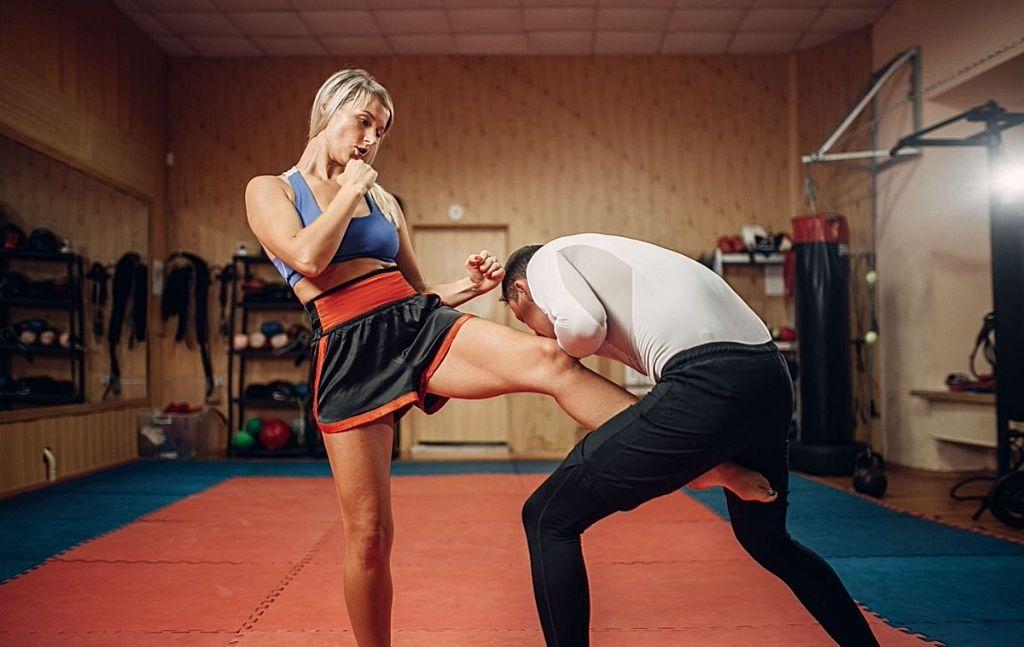
Groin Kick
A low kick can interrupt an assault long enough to move away and call for help. It should be understood as an emergency escape option, not a way to prolong a confrontation.
Training focus
Practice trajectory, balance, and recovery only with appropriate pads. After any defensive action, look for the safest exit rather than remaining engaged.
Open-hand strike
Palm-Heel Strike
The heel of the palm provides a durable striking surface while allowing the fingers to remain out of the way. The arm travels forward from a guarded position.
Training focus
Keep the wrist aligned and the elbow from locking. Learn the motion on a pad, with emphasis on withdrawing the hand and protecting the head.

Distance management
Stomp Kick
A forward stomp-style kick uses the sole of the foot and body weight to interrupt forward movement and help maintain distance.
Training focus
Do not overextend or sacrifice balance. Recoil the leg promptly and move toward safety. Claims that one kick is a reliable answer to a knife are dangerous—armed attacks are unpredictable and escape is the priority.
Last resort
Throat Strike
The throat is exceptionally vulnerable. Any strike there can cause suffocation, permanent injury, or death and should be viewed only in the context of an immediate threat of severe harm.
Training focus
Never strike a training partner’s throat. A qualified instructor can demonstrate safe target substitution and explain the legal and ethical limits of force.
Escape principle
The Bear-Hug Escape
A bear hug from behind can pin the arms against the body. The immediate goal is to stay on your feet, make space, and turn toward an exit.
Lowering your center of gravity can make you harder to lift. From there, controlled training may teach you to create space, address the grip, turn, and disengage. Because details change depending on whether the arms are trapped and whether the attacker is lifting, learn this escape with an instructor rather than improvising it.
Final thoughts
Train for Judgment, Not Just Technique
These eight movements provide a useful overview of Krav Maga, but self-defense is more than a list of strikes. Awareness, verbal boundaries, movement, physical conditioning, lawful decision-making, and knowing when to leave are equally important.
I hope you never need to use these tactics outside a controlled class. Practice with a reputable instructor so that confidence is built on sound habits rather than untested assumptions.
Continue learningExplore the Defense section →